Fatigue after stroke

More than half of all stroke survivors experience a heavy, constant exhaustion called post-stroke fatigue. It often feels like "hitting a wall" or living in a "brain fog" that doesn't go away with a simple nap. There is hope because this fatigue usually improves over time as your brain becomes more efficient.

Fatigue after stroke

Question One: Why Am I So Exhausted?


Of all the symptoms that persist after stroke, fatigue is the most common, the most debilitating, and the most consistently unexplained to survivors and their families. 

 After a stroke this happens: Intact regions begin to take on functions previously performed by damaged ones. This process often described in optimistic terms as neuroplasticity or cortical reorganisation, is real and ultimately the mechanism through which meaningful recovery occurs. But in its early and intermediate phases, it is extraordinarily expensive.The metabolic cost of recruiting alternative neural pathways is substantially higher than that of using the pathways optimised for the task over decades of use.
 
An undamaged motor cortex performing a movement has adapted over years to operate with the efficiency of a highway. An adjacent cortical region, recruited to compensate for a damaged primary motor area, operates more like a narrow country road carrying motorway traffic—it can carry the load, but only with significantly greater effort, greater wear, and far less tolerance for additional demand.


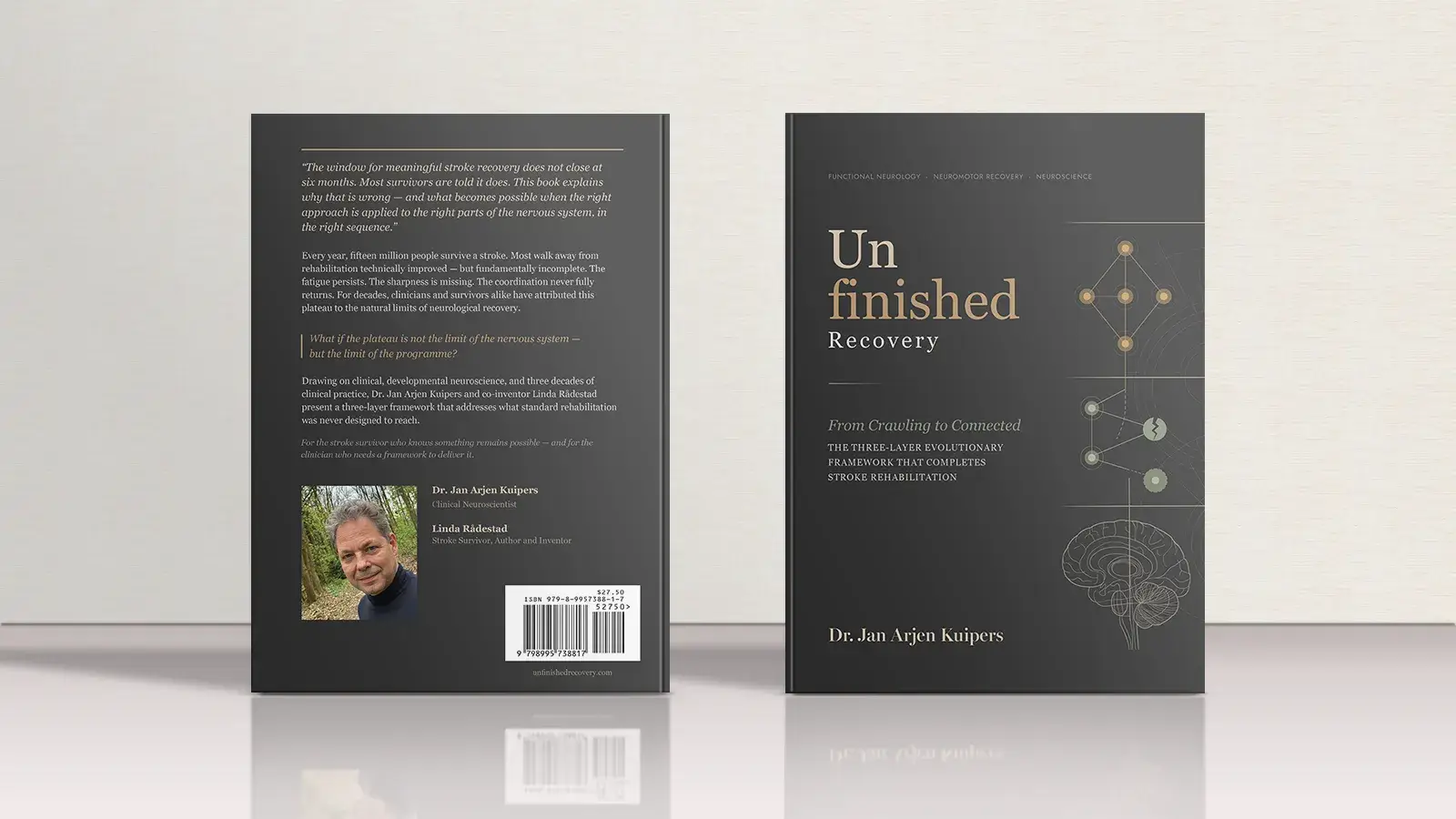
from the book "Unfinished recovery" by Dr. Jan Arjen Kuipers


Question Two: Can I get rid of Fatigue?


For many survivors, the honest answer is: not instantly, and not by attacking it directly.
But it can be meaningfully reduced, in some cases dramatically. This is achieved by addressing what is actually driving fatigue. Then it is very well possible to get rid of fatigue.Here is what we have observed in people who trained with us.

Conventional rehabilitation works from the top down. It focuses on the functions most visibly lost — arm movement, walking, speech — and trains those as the priority. That makes intuitive sense. Those are the things the survivor and the family can see.

But the brain is not a flat structure. It is layered, built over millions of years of evolution, and each layer depends on the one beneath it. The deepest layers govern the things we rarely think about: sleep architecture, breathing patterns, the basic rhythmic regulation of the nervous system. These are not glamorous. They are, however, foundational. Every higher function — movement, cognition, attention, emotional regulation — runs on top of them.

After stroke, those foundational layers are frequently disrupted. And when they are, everything costs more. The brain is already working harder than usual to reroute basic motor functions through unoptimized pathways. If it is also managing fragmented sleep and dysregulated breathing underneath all of that, the metabolic bill becomes enormous. That is where the exhaustion lives.