Balance after stroke
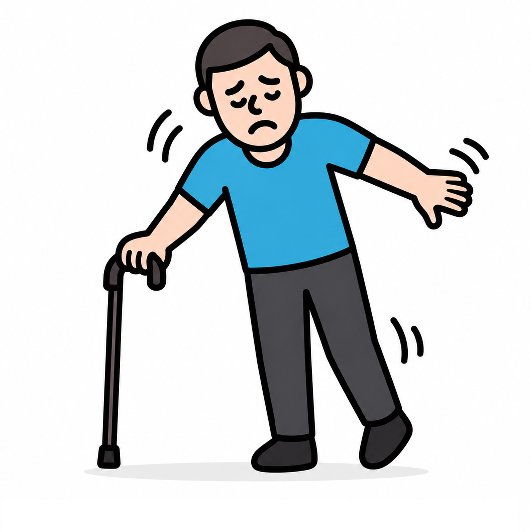
A stroke disrupts your balance because it breaks the "teamwork" between your brain and body. Here is why it happens in simple terms: Uneven Strength: Damage usually hits one side of the brain, making the opposite side of your body weak. Since balance requires both sides to work together, you become unsteady. The "Orchestra" is Out of Sync: Imagine your brain as an orchestra that lost its conductor. Your limbs are the instruments; they might still work, but they aren't playing in harmony anymore. Mixed Signals: Your brain relies on your eyes, inner ears, and "body feel" to stay upright. A stroke can scramble these signals, making you secretly lean too far forward or backward without realizing it. This often leads to falls that seem to happen "out of the blue"
Q&A

Why do I feel so wobbly and unsteady after my stroke?
Think of your brain like an orchestra that used to play perfectly together.
A stroke is like losing the conductor or several key musicians at once.
Balance isn't just about your legs; it's a team effort involving your core, your feet, your vision, and even your inner ear. Because the "team" isn't communicating well anymore, you feel wobbly. Your brain is essentially having trouble figuring out where your body is in space.
Why do I sometimes fall "out of the blue" even when I'm just standing still?
Many stroke survivors have what's called a "hidden" balance problem. Your brain thinks you're standing straight, but you've actually shifted your weight too far forward or backward without realizing it.
It's like standing on the very edge of a curb — one tiny movement can send you over because you're already so close to your "limit of stability".
Why does my therapist want me to practice rolling or crawling like a baby?
You obviously found a therapist that knows his science!
It sounds strange, but after a stroke, your body often regresses to a "baby-like" state of movement. To get back to walking steady, you sometimes have to "restart" from the ground up.
By practicing rolling, propping yourself up, and crawling, you are building the strong foundation and core strength you need to eventually stand up and walk without falling over.
Is it too late to get my balance back if my stroke was a long time ago?
Definitely not! While the first six months tap into the physical recovery phase of the brain and are the "fastest" for recovery, your brain can rewire itself your whole life.
As long as you keep practicing your exercises and keep your brain "stimulated," you can continue to see improvements in your balance and walking even decades later. (This is called neuroplasticity.)
What is the path I should follow to improve my balance?
Start from the ground up — literally. Begin with floor-level movements like rolling and propping, then progress to sitting balance, kneeling, standing, and finally walking.
Each stage builds on the last. Skipping steps often leads to falls because the foundation isn't solid yet. Work with your therapist to find where you are on this ladder and climb one rung at a time.
Is there a way to retrain the centre of balance?
After mastering the Level 1 basics first, the technique of "pushing into the weak side" can trigger a rapid response from the brain and body, immediately challenging the survivor's perception of where they should stand.
In Level 2, the change can happen very quickly because it forces the muscles on the affected side to engage and resist pressure.
Note: To keep this Q&A easy to read and practical, some scientific concepts have been simplified. The information reflects established rehabilitation and neuroscience principles but is presented in a less technical way than you would find in scientific publications.